
If imputed inflation for April and May is used, then you have inflation of over 6 per cent for two consecutive quarters, which is a worrying signal for the RBI.
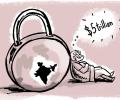
The wait for India to become a $5-trillion economic powerhouse by 2024-25 (FY25) is going to take longer than what the finance ministry had originally intended, according to the International Monetary Fund (IMF). The vision will instead be achieved in 2028-29 (FY29), reveals the IMF data, illustrating a four-year delay. Chief Economic Advisor (CEA) V Anantha Nageswaran had in February said India would become a $5-trillion economy by 2025-26 or the following year, on the back of 8-9 per cent sustained growth rate in real gross domestic product (GDP). However, the IMF data conveys that the economy will be $4.92 trillion in FY28, clearly alluding to the fact that the target will be realised in FY29.

'Government of India has the right to give directions to RBI'.

Heading to the third year, will Urjit Patel be busy firefighting a currency crisis? Almost no governor of the RBI managed to evade it and Patel perhaps knows it.

Currently, banks follow system of internal benchmarks, including Prime Lending Rate, Benchmark Prime Lending Rate, Base rate and Marginal Cost of Funds based Lending Rate.

He will be the eighth Deputy Governor to be made Governor at RBI
However, the RBI is still not in a mood to issue an OMO calendar, which was the expectation in some sections of the market.

Instead of only focusing on the tenure for which the best interest rate is available, investors should also focus on their own investment horizon.

India's services sector activities improved further and expanded at strongest rate in over 11 years in May, supported by a substantial pick-up in new business growth, even as input cost inflation climbed to a record high, a monthly survey said on Friday. The seasonally adjusted S&P Global India Services PMI Business Activity Index jumped to 58.9 in May, up from 57.9 in April, amid better underlying demand and strong inflows of new work. For the tenth straight month, the services sector witnessed an expansion in output.

India's manufacturing sector growth steadied in May, with new orders and production increasing at similar rates to those registered in the previous month, while demand showed signs of resilience and improved further in spite of another uptick in selling prices, a monthly survey said on Wednesday. The seasonally adjusted S&P Global India Manufacturing Purchasing Managers' Index (PMI) stood at 54.6 in May, little changed from 54.7 in April, pointing to a sustained recovery across the sector. The May PMI data pointed to an improvement in overall operating conditions for the eleventh straight month.
The government on Wednesday asked the Reserve Bank to maintain retail inflation at 4 per cent with a margin of 2 per cent on either side for another five-year period ending March 2026. To control the price rise, the government in 2016 gave a mandate to the RBI to keep the retail inflation at 4 per cent with a margin of 2 per cent on either side for a five-year period ending March 31, 2021.

The Governor said the MPC had voted to maintain its accommodative stance, implying more rate cuts in the future if the need arises.

'India is not so distant from years of high and entrenched inflationary expectations that it should start trying to play games with the economy the way the West's central bankers think they are entitled to,' argues Mihir S Sharma.

Industry players said they were indeed seeing a serious fall in capacity usage, though some sectors were seeming to prevent further fall in the overall capacity utilisation.
The 50-stock NSE barometer Nifty finished 14.75 points, or 0.14 per cent, down at 10,382.70 after shuttling between 10,340.65 and 10,393.15.

Ahead of the 2023-24 Union Budget, the thinking at the top level of the central government is clear: Gross domestic product (GDP) growth of 6-6.5 per cent is a comfortable enough target for FY24 and the focus should be on fiscal consolidation to ensure that the sovereign cost of borrowing does not become prohibitively expensive in a high-interest rate environment, according to people in the know. Those aware of deliberations between the Prime Minister's Office (PMO) and the Ministry of Finance said while the Budget would look to strike a balance between infrastructure investment and welfare schemes, it is unlikely to be populist, though it will be the last full-year Budget before the 2024 Lok Sabha election. Incidentally, 6-6.5 per cent GDP growth is what the upcoming 2022-23 Economic Survey is expected to project for FY24.
Central bank sees action as discriminatory, unfair

Consumer prices rose an annual 5.11 per cent (2012 base) in January.
There is a near consensus that at least a 25 basis points cut, if not 50, can be expected in the June policy.
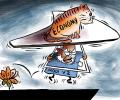
'There are deliberations on whether there can be lowering of income taxes and other sops to keep more money in the hands of taxpayers, enabling them to spend more and boost demand.'

Announcement of macroeconmic data such as industrial production and inflation, the US Federal Reserve's interest rate decision along with trends in global equities would dictate movement in the stock market this week, analysts said. Besides, foreign fund trading activity would also guide the trends in equities. "All eyes are now on the US Fed policy outcome for cues, which is scheduled on June 14. In the following sessions, the European Central Bank (ECB) and Bank of Japan (BoJ) will also announce their policy decisions.

India's consumer price index (CPI)-based inflation could ease in the coming months thanks to the arrival of kharif crops, lower international commodity prices, and a pass through of lower input costs to consumers, the finance ministry said in its Monthly Economic Review (MER) for October, which was released on Thursday. The MER, however, warned that the global macroeconomic situation remained precarious and a recession in many advanced economies would impact India's exports. "Easing international commodity prices and new Kharif arrival are set to dampen inflationary pressures in the coming months.

A rise in petrol and diesel consumption can help the government cut cesses on the fuels by Rs 4.5 a litre without impacting revenue collections of FY21, and help cool off the pressure on inflation, domestic rating agency ICRA said on Friday. Petrol consumption is estimated to increase 14 per cent in 2021-22 and diesel by 10 per cent on the lower base, rise in mobility and economic recovery, ICRA said. The rating agency added that it will result in an additional Rs 40,000 crore in revenue for the government through higher collections of the cess.

The central bank tweaked the retail inflation range to 4.8-4.9 per cent in the first half of 2018-19, and 4.7 per cent in the second half.
Headed by Urjit Patel, MPC for the fourth straight time kept the repo rate unchanged, at which it lends to the banks, at 6.25 per cent. The reverse repo, at which RBI borrows, will be 6 per cent.

'There are occasions when the prices of individual items like food raise inflation; then supply-side measures must be taken.' 'But if there is continued inflation, it means liquidity is aggravating the situation.'

The resignation is sure to create more political firestorms for the government as it comes on the eve of the winter session of Parliament where the Opposition has already made it clear to the treasury benches that infringing on the RBI autonomy would be a big talking point for them.

The poll of over 30 economists, taken in the past week, showed Asia's third largest economy will expand 7.8 percent in the fiscal year ending March 2017.

Shaktikanta Das is a master of the finest balancing act who listens to all but takes his own decisions, discovers Tamal Bandyopadhyay.
The industrial output for the third month in a row remained in the negative territory, contracting 1.5% in January

RBI said at the current juncture, the all-out effort is to maintain and sustain, with the hope that when life is secure, resources, energy and time can be marshalled to rebuild and revive.

In a business friendly move, the Reserve Bank of India on Friday said that Real Time Gross Settlement System (RTGS), used for large value transactions, will be made available round-the-clock from December. In December 2019, the National Electronic Funds Transfer (NEFT) system was made available on a 24x7x365 basis. Currently, RTGS is available for customers from 7.00 am to 6.00 pm on all working days of a week, except second and fourth Saturdays of every month.
Banks normally park almost 27 per cent of their funds in government securitie.

RBI could opt for a 'deep cut' after winning inflation war, say experts.

Given the various risks to growth, one could argue for rate cuts to be deeper than the 5 per cent terminal repo rate that we are projecting at this stage, says Kaushik Das.

'If the RBI now only prints Rs 100 in small denomination notes and the remaining amount is printed in Rs 500 and Rs 2,000 denominations, then by March-end the central bank can completely normalise the cash crunch situation.'

One incident should not be used to generalise the health of all cooperative banks, says RBI governor Shaktikanta Das.

'There are deeper, underlying, forces at work and we need institutional arrangements to guard against them.'

Finance Minister Nirmala Sitharaman has said the recent interest rate hike by the Reserve Bank was not surprising for her but the timing was, asserting that the rising cost of funds will not impact the government's planned infrastructure investments. For the first time since August 2018, RBI had on May 4 delivered a blunt 40 basis points increase in key repo rate to 4.40 per cent, and also hiked the cash reserve ratio by 50 basis points to 4.5 per cent after an unscheduled meeting of the rate setting panel, citing increased inflation pressures following the Ukraine war and the resultant spike in crude oil prices. Retail inflation printed at 6.9 per cent in March and the April reading is forecast to top 7.7 per cent.

'We are very watchful about inflation and growth. But the main challenge is economic revival and growth.'
